

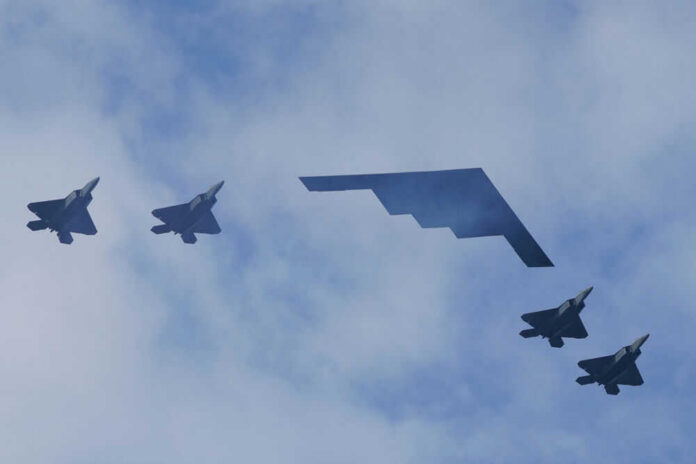
(Oldglorychronicle.com) – America’s original plan for 750 F-22 Raptors was systematically gutted to just 195 aircraft through decades of short-sighted budget cuts—leaving our nation dangerously vulnerable while China races ahead with next-generation fighter prototypes.
Story Snapshot
- The F-22 program was slashed from 750 planned aircraft to 195 built, with approximately 185 remaining operational today due to post-Cold War budget priorities
- Defense Secretary Robert Gates terminated production in 2009 to prioritize the F-35, despite Air Force requirements for 381 F-22s to maintain air superiority
- Claims of an “F-47” fighter program are unverified; the designation likely confuses the classified Next Generation Air Dominance (NGAD) sixth-generation effort
- China’s J-36 prototypes flew in late 2024 but are not operational—contradicting narratives that sixth-generation Chinese fighters are “already in the air”
- Restarting F-22 production would cost an estimated $50 billion for 194 additional aircraft, making it economically unfeasible according to 2017 assessments
How Washington Dismantled America’s Air Dominance Fleet
The F-22 Raptor program launched in 1981 to counter Soviet air threats, with initial plans calling for 750 aircraft to ensure U.S. air superiority. The Air Force selected Lockheed’s YF-22 prototype in 1991, achieving first flight in 1997 and operational capability in 2005. However, successive budget cuts devastated the program: Defense Secretary Dick Cheney reduced the order to 648 in 1990, followed by cuts to 442 in 1993, 339 in 1997, 277 in 2003, and 183 in 2004. By 2009, Gates capped production at 187 aircraft, prioritizing the multi-role F-35 over the F-22’s specialized air superiority mission despite Air Force objections.
The Real Cost of Bureaucratic Penny-Pinching
Production officially ended in May 2012 with 195 total F-22s built—177 production models, 16 test aircraft, and two development units—leaving approximately 185 operational today. The program cost $62 billion total, equivalent to roughly $92.5 billion in 2024 dollars, and supported 95,000 jobs across 46 states before the production line shuttered. A 2017 study estimated restarting production would require $50 billion to build 194 additional aircraft at $206-216 million per unit, deemed economically unfeasible. This short-term cost-cutting approach forced reliance on the F-35 for numbers, straining budgets and limiting dedicated air superiority assets to just seven operational squadrons when the Air Force identified a requirement for 381 F-22s.
The F-47 Myth and NGAD Reality
Viral claims about an “F-47” fighter replacing the F-22 lack any credible verification from official sources or defense industry reports. The designation appears to confuse the Next Generation Air Dominance program, the classified sixth-generation effort intended as the F-22’s true successor for the 2030s. The Air Force has acknowledged NGAD development with plans for approximately 200 aircraft, though specific numbers remain classified. This confusion illustrates how misinformation spreads when the Pentagon keeps legitimate programs shrouded in secrecy, fueling speculation and eroding public trust in our national defense planning at a time when clarity about our strategic capabilities matters most.
China’s Progress vs. American Procurement Failures
China’s aviation industry has made concerning strides with approximately 200 operational J-20 fifth-generation fighters and J-36 sixth-generation prototypes that flew test missions in December 2024. However, claims that China has sixth-generation fighters “already in the air” as an operational fleet misrepresent the situation—these remain in early testing phases without evidence of mass production or service entry. The narrative correctly highlights a troubling pattern: while China rapidly expands its advanced fighter inventory, America’s procurement instability created a fifth-generation stealth gap. The F-22 cuts, driven by Gates-era focus on asymmetric Middle East conflicts rather than peer adversaries, exemplify the dangerous consequences of prioritizing short-term savings over long-term strategic positioning against authoritarian regimes that don’t share our budget constraints.
What This Means for American Security
The F-22 saga demonstrates how government bureaucrats repeatedly ignored military requirements in favor of politically convenient budget gymnastics, leaving our pilots outnumbered in the skies. With only 185 operational F-22s facing China’s growing fleet of advanced fighters, the quality-over-quantity approach works only if quality comes in sufficient numbers to project power globally. The 95,000 jobs eliminated when production ended represented not just economic loss but industrial capacity that cannot be easily reconstituted. As NGAD development continues, Americans should demand accountability for procurement decisions that consistently underestimate threats from adversaries who don’t share our commitment to transparency or fiscal restraint—ensuring our next generation of air dominance doesn’t suffer the same fate as the Raptor program.
Sources:
Lockheed Martin F-22 Raptor – Wikipedia
F-22 – Air & Space Forces Magazine
Air Force F-22 Fighter Program – Congressional Research Service
F-22 Raptor – U.S. Air Force Fact Sheet
F-22 History – Lockheed Martin
Lockheed Martin Celebrates 25 Years of the F-22 Raptor – The Aviation Geek Club
Copyright 2026, Oldglorychronicle.com